Sequences are
not designs.
Nucleora is the CAD system molecular biology never had - assemble constructs from parametric parts, run continuous design-rule checks, fold and simulate locally, and ship an auditable release record.
tables
workbench
uploaded
Electronics has CAD.
Mechanical has CAD.
Architecture has CAD.
Molecular biology has a text box with ATGC in it, a folder of Benchling tabs, and a spreadsheet.
Nucleora treats a DNA or mRNA construct the way an engineer treats any other design. Parts. Constraints. Checks. Simulation. A release you can hand to someone.
THE SHIFT - 002
A sequence you type and then analyze
A design you assemble, constrain, simulate, verify, and release
THE TOOL - 003
One environment. The full workflow.
From antigen to auditable release record - without switching tabs.
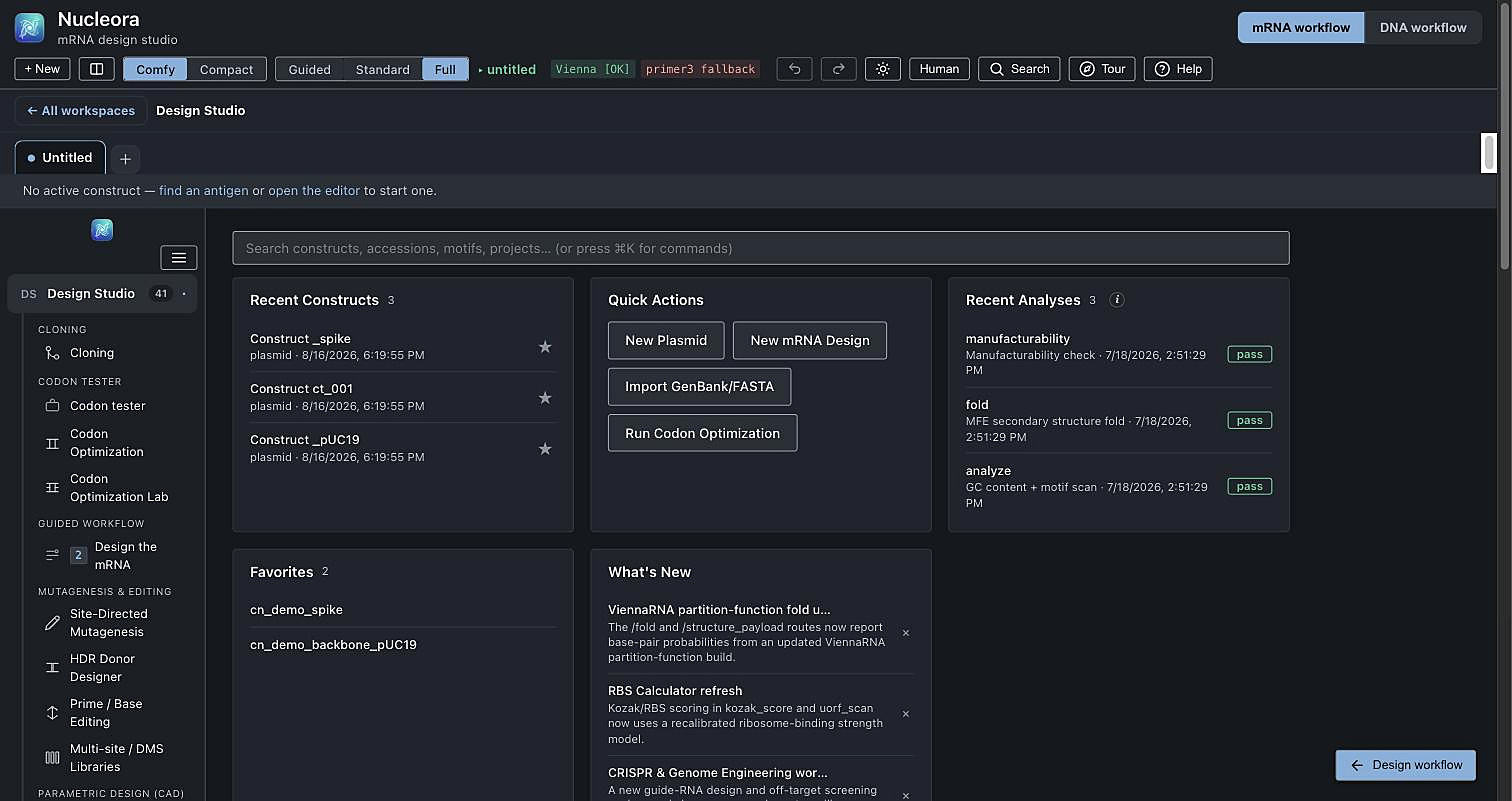
HOME - Dashboard and project overview
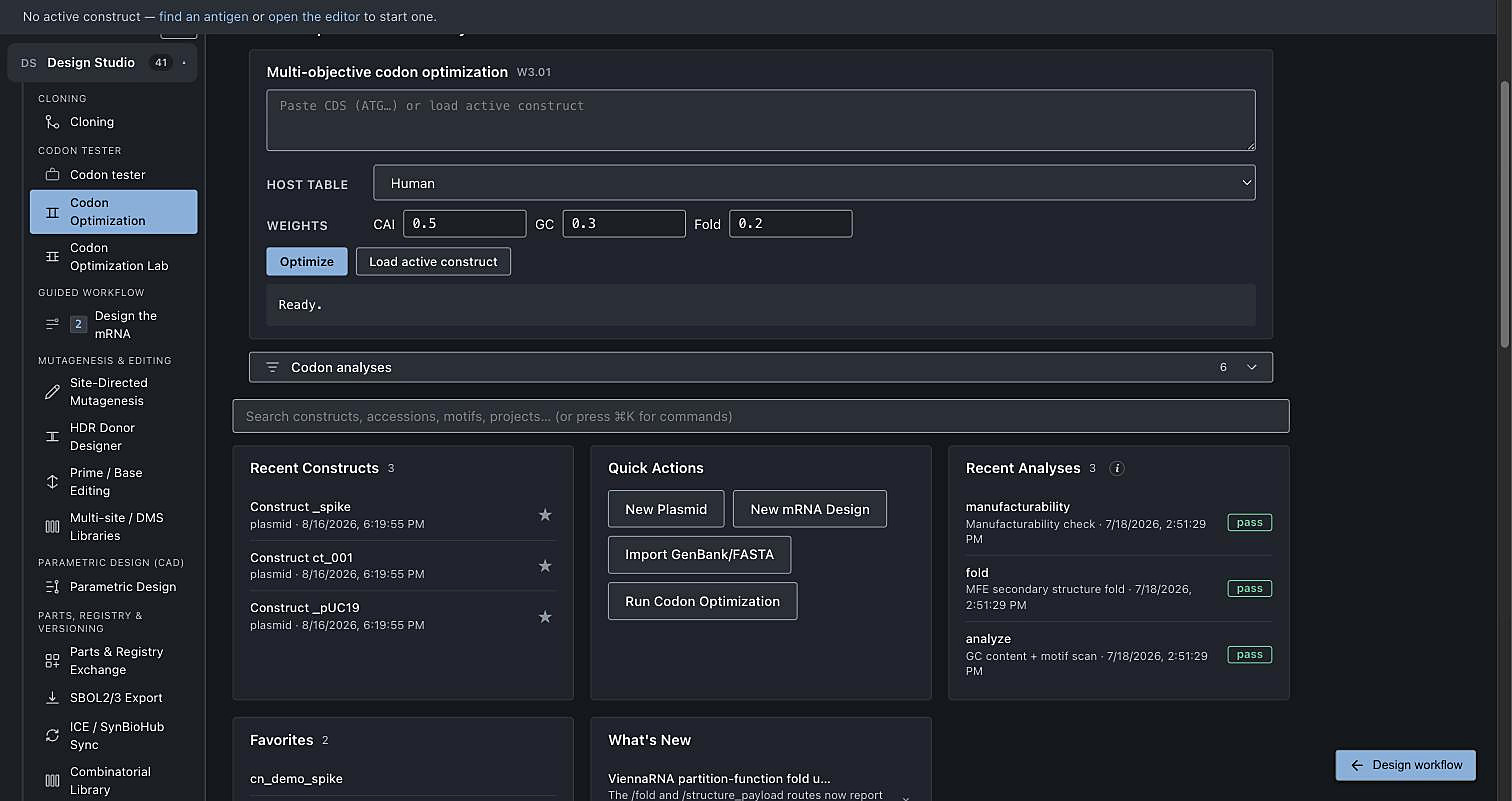
DESIGN STUDIO - 41 tools including cloning, codon optimization, and mutagenesis
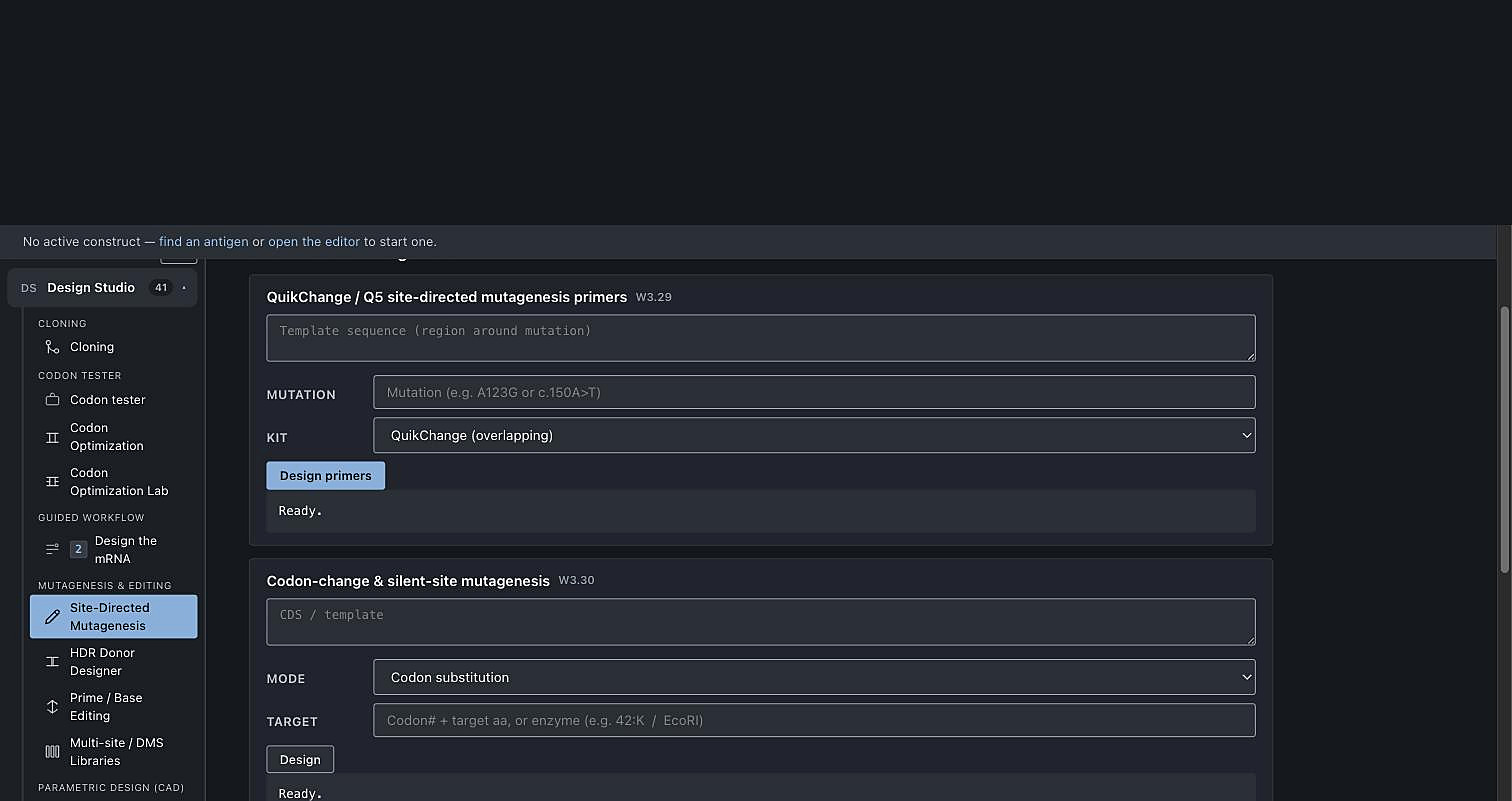
SEQUENCE EDITOR - mRNA linear, IVT plasmid circular, with auto-annotation
ANALYSIS & QC - Align sequencing results to your design, classify every variant
THE ARCHITECTURE - 004
Five pillars. Every mature CAD system has them.
No nucleic-acid tool has had all five.
Canvas
Schematic capture
Construct your design from parametric parts - not by typing characters. Change poly(A) from 80 to 120 and the sequence regenerates underneath you. The sequence is a rendering of the design, never its source of truth.
- Drag-and-drop part assembly
- Bidirectional sequence sync
- mRNA, DNA, IVT plasmid views
Library
Versioned, provenanced parts
Every part carries its provenance - the database, the accession number, the date it was fetched. Codon tables tallied from real RefSeq coding sequences. When a species doesn't have one, Nucleora names the proxy it used.
- Real codon data, or it tells you
- Provenance on every part
- Sample library included
Constraint Engine
Design rules that fail loudly
Design rules run continuously - like a spell-checker. It finds the homopolymer run your synthesis vendor would have rejected, explains why in plain language, and offers the fix before you ever place an order.
- Rules across multiple categories
- Plain-language failure explanations
- Synonymous-substitution fixes
Simulator
Physics in the loop
Fold locally with ViennaRNA. Watch the structure change as you edit. Walk the template through the IVT run before it costs anything: predicted yield, manufacturability grade, and an itemised order form - all computed on your machine.
- ViennaRNA local fold
- Manufacturability grade + yield
- IVT run simulation
Release Path
From intent to auditable artifact
One signed, immutable release record: the design revision, every check, every waiver, every simulation result, and the bill of materials. SBOL export. 21 CFR 11 signatures. The full audit trail - in a format another person can verify.
- Signed, immutable release records
- SBOL export
- 21 CFR 11 audit trail
DESIGN RULE CHECK - 005
It fails here.
Not at the bench.
A homopolymer run of A×9 will cause your synthesis vendor to reject the order. Nucleora's DRC-014 catches it before you send it. Three synonymous substitutions later - the protein is unchanged, the construct ships.
The error costs you ten seconds on screen. At the bench it costs $4,000 and three weeks.
Synthesis vendors reject homopolymer runs ≥ 8 nt.
Your vendor would have rejected this order.
TRY IT - LIVE
Paste a sequence. See the checks fire.
No install. No account. A preview of what Nucleora does - right here, right now.
Runs entirely in your browser — no data leaves this page. Full analysis (design rules + ViennaRNA folding) available in the Nucleora app.
LOCAL-FIRST - 006
Your sequences never leave the building.
Not a data-harvesting cloud. Works on a plane, in a BSL-3, air-gapped.
Runs on your machine
ViennaRNA, codon tables, DRC, fold simulation - all local. No API keys. No account required.
BSL-3 and air-gap ready
No outbound connections required after install. Works in regulated environments where cloud tools cannot go.
Method-transparent
Every computed number traces to a named, published method. No confident guesses. We publish the benchmarks we lose.
Testing available upon request
Full workbench. No crippled tier. Academic and commercial use welcome. Request access - join the list.
WHO IT'S FOR - 008
"Assemble a construct from parametric parts, fold it as you edit, and catch the homopolymer run before your vendor does. 350+ tools underneath when you need them."
"Local-first design for regulated work: continuous design-rule checking, 21 CFR 11 signatures, an immutable audit trail, and a single signed release record tying the design, checks, waivers, and BOM together. Nothing leaves your infrastructure."
"The full workbench, no crippled tier. Version control, reproducible results, and every computed number traced to the paper it came from."
"Built for the animals that don't have a codon table yet. Where a species doesn't have real data - an okapi, a bongo - Nucleora names the proxy it used. It never approximates silently."
OPEN DATA - 009
Real codon tables.
Real species. Real data.
Codon usage tables calculated from RefSeq CDS sequences - not interpolated, not approximated. Every table names its source.
Browse codon usage data →mRNA ANATOMY - 010
Every part of the construct.
Designed, not typed.
Nucleora lets you assemble mRNA constructs from parametric parts. Change one element - the sequence regenerates underneath you.
FAQ - 011
Common questions.
Nucleora is currently in closed testing. Access to the full workbench is available upon request — academic and commercial users are both welcome. There is no crippled trial and no feature gating. Join the waitlist and we'll reach out when a seat opens.
No. Nucleora is local-first: all design, computation, and simulation happens on your machine. No sequences are uploaded. No account is required. You can run Nucleora on an air-gapped machine with no internet connection after the initial install.
Nucleora runs natively on macOS (Apple Silicon and Intel, macOS 12+) and Windows 10/11. A Linux build is in progress. The same .ncl project files work across both platforms.
Codon tables are tallied directly from RefSeq CDS sequences - not modelled or interpolated. When a species doesn't have enough data, Nucleora uses a documented proxy and names it explicitly. The benchmarks we run are published on the Methods page, including the ones where we lose.
Nucleora includes 21 CFR 11-compatible audit trails, signed release records, and SBOL export - designed to support regulated workflows. It is a design tool, not a medical device. Constructs intended for human use still require institutional biosafety review and applicable regulatory submission.
Design rules run continuously as you edit. They cover synthesis vendor limits (homopolymer runs ≥8 nt, problematic GC windows, repeat elements), mRNA biology (UTR secondary structure ΔG, Kozak conflicts, internal ribosome entry), and regulatory sequences. Every failure includes a plain-language explanation and, where possible, a synonymous-substitution fix that leaves the protein unchanged.
LOCAL-FIRST EXPLAINED - 013
Cloud tools vs. Nucleora.
What happens to your sequences depends entirely on where computation runs.
COMPARISON - 014
How Nucleora compares.
An honest look at the tools people actually use for DNA and mRNA design.
| Feature | Nucleora | Benchling | SnapGene | UGENE |
|---|---|---|---|---|
| Local-first (no upload) | ✓ | - | ✓ | ✓ |
| Continuous design-rule check | ✓ Continuous | Partial | - | - |
| Codon optimization | ✓ 33 species | ✓ | - | Basic |
| Local RNA folding (ViennaRNA) | ✓ | - | - | mfold |
| mRNA full construct workflow | ✓ End-to-end | Limited | - | - |
| IVT run simulation | ✓ | - | - | - |
| 21 CFR 11 audit trail | ✓ | ✓ | - | - |
| SBOL export | ✓ SBOL 3 | ✓ | SBOL 1 | - |
| Access model | ✓ By request | Limited | Paid | ✓ |
Features reflect publicly stated capabilities as of mid-2026. Partial = feature exists with limitations. Nucleora is in active development.
CHANGELOG - 015
What's new.
Nucleora is in active development. We ship regularly.
ROADMAP - 016
What's coming.
Nucleora is in active development. These features are in progress or planned for the next release cycle.
EARLY ACCESS - 017
In active development.
We're building the CAD tool molecular biology never had. See how it works →
Nucleora is a research and education tool for designing DNA and mRNA sequences using public reference genomes. Not a medical device. Constructs intended for cells, animals, or humans require institutional biosafety review and applicable regulatory approval.